Are Mystery Boxes Legit? A 10-Point Safety Checklist
Mystery boxes can be a legitimate product, but the format also gives a dishonest seller room to hide weak goods, invent prize claims, or simply never ship. You should not decide from an unboxing video or a big discount. The safer way is to check five things before you pay: the seller, the written promise, the total cost, the payment process, and the support you would get after delivery. This checklist walks you through all five in about ten minutes.
Are Mystery Boxes Legit?
Yes, the business model can be legitimate. A real seller charges you a fixed price, selects products within a stated category, packs a physical box, and ships it. Retailers and liquidators also sell overstock, returns, or mixed goods honestly when the condition is disclosed. That does not make every website legitimate. You need to answer two separate questions: is a mystery box a real type of product, and does this specific seller give you enough evidence to trust this specific offer?
Scam pages use a real product trend as cover. They imitate a known retailer, promise premium goods for a tiny payment, add false countdowns, or collect your card and personal details without delivering what was advertised. The checks below are designed to separate those pages from the real ones.
Start With the Written Promise
- A legitimate box keeps the products random but fixes the price, count, condition, category, delivery terms, and problem process in writing.
- A very low price is not proof of a scam; a tiny payment paired with a near-certain premium promise is.
- Verify the seller, not the ad: contact details that work, a consistent domain, and reviews that describe real orders.
- Pay with a method that gives you a record and a dispute path, and save the page you bought from.
Ignore the most exciting image for a moment and write down exactly what the page promises you. A physical box should normally state the price, an item count or another measurable quantity, the product category, the condition, the important exclusions, the shipping destinations, the dispatch time, the estimated transit time, and how you report a problem. The promise does not need to reveal every product. It does need to draw a boundary around the surprise.
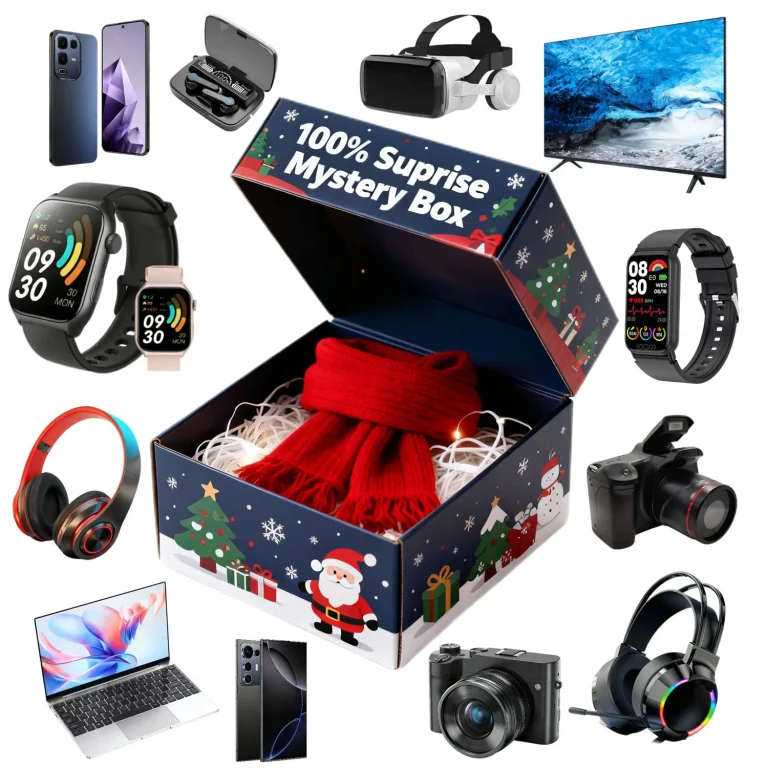
Be cautious when a page names high-value possibilities but stays vague about the ordinary contents. A picture of a phone, laptop, or games console is not a guarantee to you. Look for direct language that says whether images are examples and whether any named item is promised.
Check Whether the Price Claim Makes Sense
An unusually low price is not proof of a scam. Wholesale buying, overstock, generic products, or a small item count can all bring the cost down. The warning sign is the combination: a very small payment and a near-certain premium promise. Security researchers have documented mystery-box scams that advertise expensive products for only a token charge or a shipping fee, where the page exists to capture your card details or set up repeat payments.
Ask yourself four things. Is the offer selling a defined physical box, or only the chance of a prize? Is the "free" box conditional on earlier spending, a membership level, or separate shipping? Is a recurring charge disclosed near the buy button? Does the total at checkout match the advertised price? And do not rush because a timer says stock is running out. A legitimate decision survives a few minutes of checking.
Verify the Seller's Identity
Look beyond the product page, because the product page is the part a scammer polishes.
Contact information
The site should give you a working way to reach the seller. A domain email, a business address or supplier context, and a consistent customer-service channel are stronger than an anonymous form alone. Send a narrow pre-sale question and judge whether the reply actually answers it.
Domain and brand consistency
Look for spelling changes, extra words, or a domain that imitates a known retailer. Scam ads claim affiliation with Amazon, Apple, or another brand without proof. A seller offering returns or liquidation goods is not automatically the original retailer, and should not imply it is.
Independent history
Search the business name plus "reviews", "complaints", "shipping", and "refund". Read recent positive and negative reports, and do not rely on a testimonial carousel the seller controls. Reviews are supporting evidence, not a guarantee. Look for specific descriptions of ordering, delivery, condition, and problem resolution rather than repeated generic praise.
Read the Condition Statement
Mystery boxes can contain new products, overstock, returns, refurbished items, open-box stock, or a mix. Each can be sold legitimately when it is described honestly. Do not assume that "unclaimed", "Amazon", "warehouse", or "premium" tells you the condition. Some viral offers misuse the idea of unclaimed packages or retailer returns. Real liquidation supply chains exist, but a specific seller should still explain its source and condition without pretending to be the original retailer.
For electronics, also look for testing information. "Inspected" can mean many things, so check whether the seller explains what happens when an item arrives damaged or does not work. The condition ladder, and the three questions that cut through vague wording, are in how to read condition on a mystery box.

Read Shipping Before You Pay
A real product still becomes a bad purchase for you when the delivery terms are hidden. Confirm the countries served, where the parcel ships from, the processing time before dispatch, the estimated transit after dispatch, whether you get tracking, the shipping cost at checkout, any import duties, and what happens if the parcel is delayed or lost. Processing and transit are different clocks; a five-day transit estimate does not help you if the seller never says how long packing takes.
Mewoo publishes its destinations, dispatch window, transit estimate, and customs note on its Packing, Shipping & Tracking page. Whoever you buy from, use the current policy page, not an old social-media caption, when you decide.
Check the Damage and Replacement Rules
A random product mix does not remove the seller's responsibility to tell you how problems are handled. Look for the reporting deadline, the photos or video required, whether you must keep the label and packaging, which problems qualify, whether preference or model variation is excluded, whether the remedy is a refund, replacement, or equivalent item, and who pays return shipping. A policy can be strict and still be clear. Your risk is highest when the seller offers no written path at all.
| What you are checking | Good sign | Walk away if |
|---|---|---|
| The promise | Count, condition, category, exclusions in writing | Only a photo and an adjective |
| The price | Total visible before payment | Shipping appears after card details, or a recurring charge is hidden |
| The seller | Working contact, consistent domain, specific reviews | Claims to be a big retailer with no proof; contact form only |
| Delivery | Dispatch and transit stated separately, tracking included | "Fast shipping" and nothing else |
| Problems | A deadline, an evidence list, a stated remedy | "All sales final" with no fault route |
Protect Your Payment
Use a payment method that gives you a record and whatever protections are available to you; the options are compared in which payment methods actually protect you. Check that the checkout domain matches the store and uses a secure connection. Never send card details, passwords, or identity documents through chat because a seller asks casually.
Be especially careful after clicking a social-media advertisement. Confirm the final domain instead of assuming the page belongs to the brand in the ad. Stop if checkout adds an undisclosed subscription, changes the amount, or redirects through unrelated domains. And save the product page, order confirmation, receipt, and the policy in effect when you ordered. Those records make any later support request much clearer.
Note: One weak detail may be a mistake. A cluster of weak details is a decision signal. Leave the site when several of these appear together: a premium device presented as almost certain for a tiny price, a retailer affiliation with no proof, no condition statement, reviews that are all vague and identical in style, a countdown that resets when you refresh, contact details that do not work, or a checkout that creates a recurring charge without clear consent.
Your 10-Point Safety Checklist
- Can you identify the seller and contact it?
- Does the site clearly describe a physical product or an online prize model?
- Do you know the item count or another measurable promise?
- Is the product condition stated?
- Are category limits and exclusions explained?
- Is the total checkout cost visible before payment?
- Are dispatch and transit times separated?
- Is there a written process for damaged or non-working items?
- Does the checkout avoid hidden recurring charges?
- Would the ordinary stated outcome still be acceptable to you without a premium item?
A seller does not become legitimate because it passes one check. The checks work together, and a seller that passes all ten is one you can order from with your eyes open.
FAQ
Are "unclaimed Amazon package" mystery boxes real?
The supply chain behind them is real: undeliverable mail and retailer returns do get auctioned in bulk and resold. What is usually not real is the implied link to Amazon, and the suggestion that you are getting someone's lost order intact. By the time such goods reach a box they have been sorted several times. Judge the seller on who they actually are and what condition they state, not on the story in the ad.
Is a free mystery box always a scam?
Not always, but treat the word as a question rather than an answer. Genuine free boxes are usually a reward for spending, a loyalty tier, or a promotion with a shipping charge that reflects real postage. The scam version pairs a token fee with an unrealistic premium promise, or quietly enrols you in a monthly plan. Read the whole offer and the checkout total, and if you cannot find the catch, assume it is the recurring charge.
Can online reviews prove that a seller is legitimate?
They can raise or lower your confidence, but they cannot settle it, because both fake praise and fake complaints exist. Give weight to reviews that mention the boring details: how long the parcel took, what condition items were in, what happened when something was faulty. Give none to a wall of five-star one-liners. Then check the policies and the checkout anyway, because a seller with good ratings can still have bad terms.
What is a brushing scam, and is it a mystery box?
No. Brushing is when a parcel you never ordered turns up, typically so that someone can post a "verified" review in your name. It has nothing to do with a box you chose to buy. If an unexpected package arrives, do not scan any code inside it, check your shopping accounts for orders you did not place, and follow your postal service's guidance on unsolicited parcels and fake reviews.
Should a legitimate seller tell me every item before I buy?
No, and one that did would not be selling a mystery box. What you are entitled to is the frame around the surprise: the price, how many items, what condition they are in, the categories they come from, what is excluded, how and when it ships, and what happens if something is broken. If those are written down, the randomness inside them is the product you chose. If they are missing, the randomness is all there is.
What evidence should I keep after ordering?
Screenshot the product page, the price, the condition line, the shipping page, and the returns or replacement policy on the day you order, because pages change. Keep the order confirmation and payment receipt. When the parcel lands, photograph the label and the outer box before you open it, and keep the packaging until you have tested everything. If a dispute ever happens, that folder is what decides it.
Final Thoughts
A mystery box is legitimate when the seller limits the uncertainty and documents the rest. Before you let yourself enjoy the surprise, verify the condition, the item promise, the total cost, the delivery path, the payment, and the support. Mewoo lists its product boundaries in What You Can Expect Inside and its issue handling in the returns, damage and after-sales guide, so you can run the checklist against it yourself.
If you want to test a seller before committing, a small first order is the cheapest way to check every point above against a real parcel: Discovery Electronics Mystery Box (1 item) and Double Surprise Electronics Mystery Box (2 items). Compare every tier side by side on the electronics mystery box category page.
Shop Mystery Boxes →