Mystery Boxes for Children: What Changes and What to Check
Buying a mystery box for kids sounds like the same purchase as buying one for yourself, with brighter packaging. It is not. The decisive question for you is whether the thing you are buying counts as a children's product at all, because that single classification switches on an entire safety framework: age marking, a small parts ban, a warning label, and a certificate you can ask for. A general assortment has none of it.
The Question That Decides Everything
Before you compare prices, work out which of two things is in front of you. A children's product is designed and marketed for children, and therefore inside the regulatory framework: an assigned age band, testing, labelling, certification. An adult assortment with cheerful packaging is a surprise box for kids in name only. Nothing was assessed against a children's standard, because the rules were never engaged. Both are sold under the same search terms, and a box your child will genuinely enjoy can be either. The second is not defective or dishonest; it simply is not what the words imply, and the difference matters more to you than anything else on the listing.
What the Rules Actually Require
- Small parts are banned outright in products for children under three.
- The choking warning must appear in the advertising, not just on the box, so you can check the listing itself.
- You can ask a seller for the Children's Product Certificate, and the reply tells you a lot.
- For a general electronics box in a house with small children, you unpack, sort, and check battery compartments before anything is handed over. Kitchen gadgets need a food-contact check on top, in kitchen gadgets from a mystery box. A box meant for a classroom rather than a home has a limit of its own, in a mystery box as a teacher gift or classroom prize.
The US Consumer Product Safety Commission publishes the requirements, and three of them are directly checkable by you. The small parts ban: children's products intended for children under 3 that present a choking, aspiration, or ingestion hazard because of small parts are banned hazardous substances, codified at 16 C.F.R. part 1501. A small part is anything that fits entirely into a specified cylinder without compressing, including a piece that breaks off during use and abuse testing. The warning label, including in the advertising: certain children's products containing small parts, balloons, small balls, or marbles must warn you not to buy them for children under a stated age, under 16 C.F.R. § 1500.19, and any advertising for such toys must use the same warning, under § 1500.20. The certificate: Section 14(a) of the Consumer Product Safety Act requires manufacturers and importers of children's products subject to a CPSC rule to certify compliance by issuing a Children's Product Certificate.
The advertising rule is the useful one for you, because it applies to the page you are reading rather than to a box you have not received. If a box is genuinely marketed as a children's toy containing small parts, the choking warning should appear in the advertising itself. A listing that presents itself as a kids toys mystery box with no age band and no warning anywhere is telling you something: either it is not actually being sold as a children's product, or the requirement is not being met. Both are reasons to slow down. The certificate is the second test, and it costs you one message. Asking a seller of a children's product for its Children's Product Certificate is a normal request. The quality of the reply sorts serious sellers from people reselling whatever arrived.
Why an Electronics Box Is Not a Children's Box
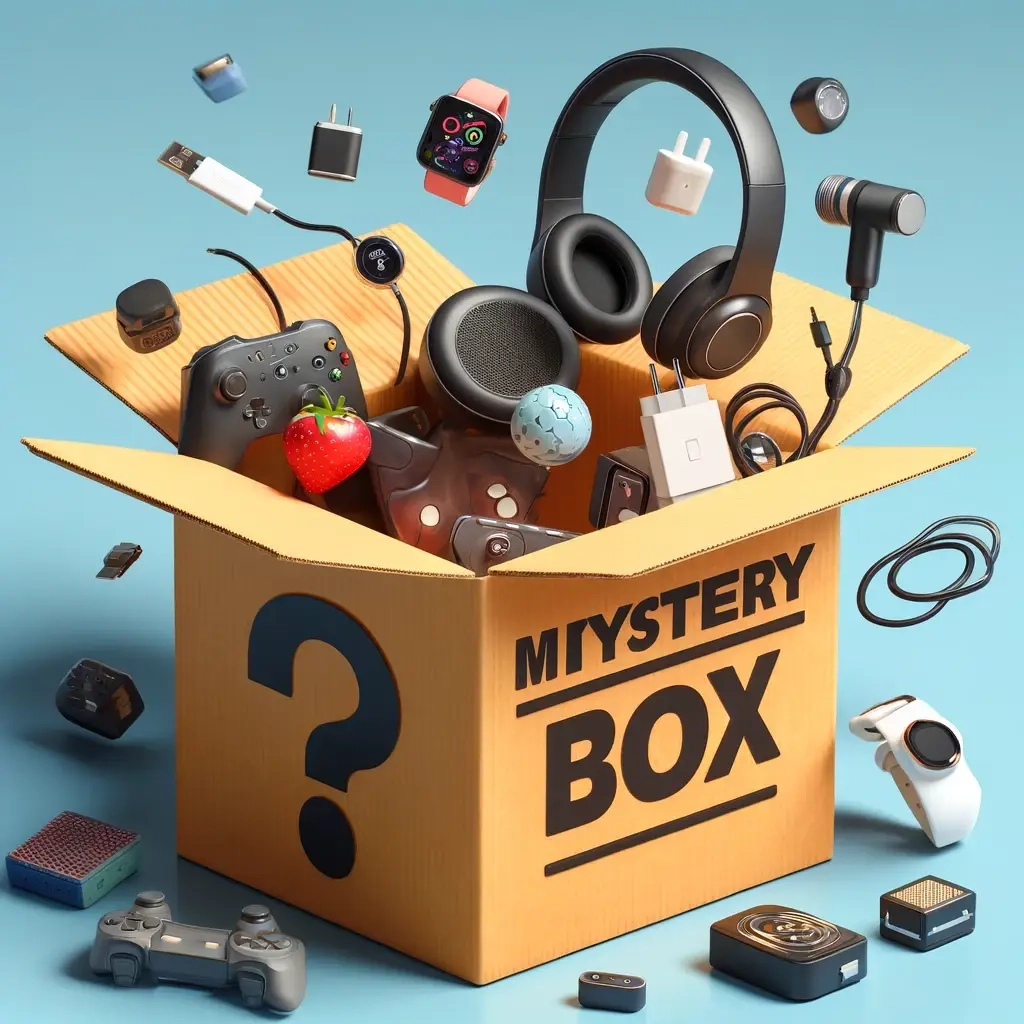
This is the practical consequence if you are considering a general assortment for a child. A mixed tech box contains loose cables, earbud tips, clips, adapters, and small connectors. Nobody assigned it an age band, nothing was measured against the small parts cylinder, and no choking warning was required, because it is an adult product. The absence of a warning is therefore not reassurance for you. It is the absence of an assessment. That distinction is the single most important thing in this article, and it is covered further in toy mystery boxes and electronics boxes follow different rules.
By Age
| Age | Suitable format | The real risk | What you do |
|---|---|---|---|
| Under 3 | Age-marked toys only | Choking on small parts | Never a general assortment |
| 3 to 7 | Toy blind box with age band | Small parts, disappointment | Check the marking, open with them |
| 8 to 12 | Toy box; tech only if sorted | Duplicates, comparison with siblings | You unpack first |
| 13 and up | Either, with supervision of chargers | Unrealistic expectations | Say what the format is beforehand |
Note: If a general box is coming into your house with small children, unpack it away from them and sort before anything is handed over. That ten-minute step is the entire safety layer for an adult product, and it is the layer the regulations would otherwise have provided. Keep the packaging until you have checked every item, and the teenage middle ground is covered in mystery boxes for teenagers.
The Disappointment Problem Is Real Too
Safety is the part with rules attached. The other failure mode has none and happens more often. Children compare. A mystery box a child receives at the same time as a sibling invites an immediate comparison of contents, and randomness guarantees the comparison will sometimes be unequal. Adults absorb that; children frequently do not. Three things reduce it for you: buy the same tier for each child rather than the same product, open them separately rather than side by side, and say beforehand that the boxes are different on purpose, so unequal contents are the game rather than an injustice. The other half is expectation. A child who has watched unboxing videos may expect something the price cannot contain, which is worth a sentence from you before the lid comes off.
Batteries Are the Other Thing to Check
One hazard sits outside the small parts rules and deserves its own look, because it is common in anything electronic. Button cells, the small round batteries in remotes, light-up novelties, and cheap gadgets, are dangerous if swallowed, and the risk is not choking but chemical injury. Any item containing one should have a battery compartment that needs a tool to open, and anything with a compartment a child can open by hand does not belong in your house with small children regardless of what else the box contained. This applies to a children's mystery box and to an adult box equally, and it is a check nobody performs because the batteries are inside things rather than loose. Open every compartment during your sorting step, not later.
Where the Format Genuinely Suits Children
Easter and party bags: small items, several recipients, low stakes, and nobody keeps score. A countdown broken from one box: one purchase redistributed across mornings, which suits a child's attention better than a single pile; the method is in building a countdown from one mystery box. Collecting age, with a real series: where a roster exists, the chase is the point and duplicates can be traded. Teenagers with stated interests: old enough for the safety framework to matter less, young enough to enjoy the reveal. It suits under-threes not at all, and that is worth saying to you without qualification.
FAQ
Is a mystery box safe for a child?
Only a box sold as a children's product has been through the checks that make that word mean something: an age band, testing for small parts, and warning labels. A box of adult gadgets in colourful packaging has been through none of them, and the seller has done nothing wrong by skipping them, because the rules never applied. So look for an age marking first, and if there is none, you are the safety check.
What does the small parts rule actually say?
In plain terms: if a product is meant for a child under three and any piece of it could lodge in a small throat, US law treats it as a banned hazardous substance. Regulators use a test cylinder shaped like a toddler's throat, and anything that fits inside it, including bits that snap off during rough handling, counts. That is the standard a proper children's product was measured against and an adult box never was.
Should the listing show a choking warning?
If it is a children's toy with small parts, yes, and not only on the box: US rules require the same warning in the advertising, which means on the web page you are reading. A listing calling itself a kids mystery box that shows no age band and no warning anywhere is either not really a children's product or is skipping a requirement, and either way you should not assume it is safe for a young child.
Can I ask a seller to prove compliance?
Yes, and it is a perfectly ordinary thing to do. Federal law obliges whoever makes or imports a regulated children's product to hold a compliance certificate for it, so request a copy before you pay. A serious seller sends it or explains it in a sentence. Someone reselling a pallet of toys they know nothing about will stall or go quiet, and that silence is your answer.
Can I give an electronics box to an older child?
To a teenager, yes, as long as you open and sort the box first and keep an eye on anything that plugs in or charges. To a younger child, no. The loose cables, earbud tips, clips, and adapters in a general tech box are precisely the shapes the choking rules were written to catch, and nothing in that box was ever measured against them. Keep it for the older kids and choose an age-marked toy box for the little ones.
How do I stop siblings comparing contents?
Give each child the same size of box rather than the identical product, let them open at different times instead of side by side, and tell them before they start that the boxes were made different on purpose. Framed that way, getting something your brother did not is the fun of it. Left unframed, a child reads the same difference as unfairness, and you spend the afternoon refereeing.
Final Thoughts
Decide first whether you are buying a children's product or an adult assortment with bright packaging, because only the first carries an age band, a small parts ban, and a warning that must appear in the advertising too. For a general box entering your house with small children, you are the safety layer: unpack away from them, check every battery compartment, sort, then hand over. Under three, do not buy one at all.
If you are buying for a younger recipient, a low item count is the easier thing to supervise: Surprise Gift Box (3 items) and Electronics Blind Box (2 items). Compare every tier side by side on the electronics mystery box category page.
See what an adult box can contain →