
The Pages a Mystery Box Website Should Have Before You Buy
With most products you judge the seller by the product page. With a mystery box you cannot, because the product page is deliberately vague about the one thing you want to know. So your assessment moves elsewhere: to the policy pages sitting quietly in the footer. This guide shows you what each of them is for, which absences actually matter to you, and the five-minute check that tells you whether a mystery box site is worth your money.
Why the Footer Matters More Here Than Anywhere Else
A normal listing tells you what you are buying. You compare the specification, the price, and the reviews, and the seller's policies are a secondary consideration. A mystery box inverts that. The contents are unspecified by design, so there is no specification for you to compare. What is left is everything the seller has committed to in writing: item count, condition, dispatch time, and what happens when something goes wrong. Those commitments do not live on the product page. They live in the footer. Which means the footer is not boilerplate here. It is the product description.
Two Kinds of Page, and Only One of Them Binds
- Commitments bind the seller to you; disclosures only describe the product. You want both.
- A stated dispatch window is the most load-bearing sentence on the site.
- Exclusions tell you more than inclusions, because they cost the seller something to state.
- Reviews hosted on the seller's own site are the weakest signal available to you.
Every page worth checking falls into one of two groups, and telling them apart is most of the skill. Commitments say what the seller owes you: when it ships, what counts as a fault, how long you have to report one, what a refund looks like. You can point at them. Disclosures say what you are buying: the categories, the exclusions, the condition, the item count. These are not promises about your specific box, but they tell you the shape of the thing. A site heavy on disclosures and light on commitments is describing a product without standing behind it. A site heavy on commitments with vague disclosures is at least accountable, even if you are still buying blind. The combination you want is both.
The Pages, and What Each One Is For
| Page | Type | The one thing you should find on it |
|---|---|---|
| Shipping and delivery | Commitment | A stated dispatch window, separate from transit time |
| Returns and faults | Commitment | What counts as a fault, and the reporting window |
| Terms and conditions | Commitment | Whether item count and condition are actually promised |
| What is inside / categories | Disclosure | Exclusions, not inclusions |
| Condition and grading | Disclosure | New, used, refurbished, or untested, stated in words |
| Contact | Commitment | A route to a human that is not a form alone |
Note the third column on the categories page. Any seller will list what could be inside, because that reads as generous. Far fewer publish what is excluded, and exclusions are the more informative half for you; they are the only part of a category range that costs the seller something to state.
The Shipping Page Is the Load-Bearing One
If you check one page, check this one, because a specific rule attaches to it. The US Federal Trade Commission's Mail, Internet, or Telephone Order Merchandise Rule applies to most things you order online. Sellers have to ship within the time they or their ads say, and if they do not give a time, they must ship within 30 days of your order. If there is a delay, the seller has to tell you and give you the choice of agreeing or cancelling for a full refund. And if the seller does not ship at all, it must refund you in full, not in store credit.
Sellers of assorted boxes often need longer than a normal retailer, because contents are selected and checked per order rather than picked from a bin. That is legitimate, and a stated window of several days is not a warning sign. The problem is silence. A site that states no dispatch time at all has not avoided a commitment; it has accepted the default one. Thirty days is a long way from what you assume when you order a gift, and a seller who never mentions timing is the one most likely to use all of it. So the useful question for you is not "how fast do they ship" but "have they written a number down". Mewoo's own windows sit on its packing, shipping and tracking page, and the arithmetic of adding dispatch to transit is in when to order a holiday mystery box.
Which Absences Actually Matter to You
Not every missing page is a red flag. Small sellers legitimately run without elaborate documentation. What matters is which specific thing is missing, because each absence removes a different ability from you. No dispatch window: significant; you lose any basis for knowing when to worry. No fault process: significant; this is the page you will need if you need any page at all. No stated item count: significant; without a number, "several items" can mean two. No condition statement: moderate; silence usually means the cheaper answer. No exclusions listed: moderate; the category range is decorative rather than real. No company address: mild on its own, meaningful combined with the above. No about page: minor; pleasant to have, decides nothing.
Note: Read the terms page for what it says about the assortment specifically, not just for the generic clauses. The useful sentence is whether the seller commits to an item count and a condition, or only to "a selection of products". The second phrasing commits to nothing, it is common, and it is the sentence you will be arguing about if something arrives short.
Three Things That Look Like Trust Signals and Are Not
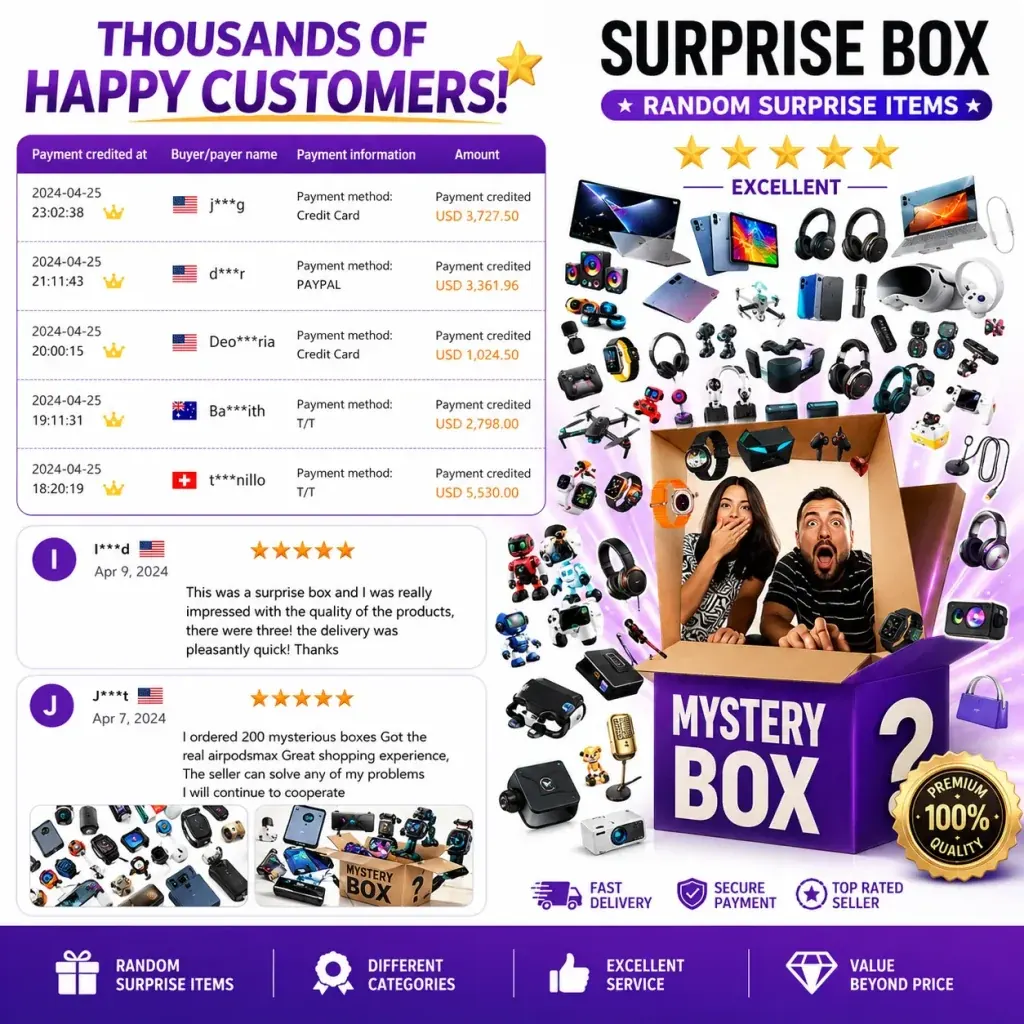
All three are extremely common on this category's sites, and none of them tell you anything. Reviews hosted on the seller's own site are controlled by the person selling to you; a wall of them is a design decision rather than a track record. Payment screenshots and order tickers, lists of recent purchases with partly hidden names, are a persuasion device that proves the site can render a table. Quality badges the seller made, "100% quality" or "top rated seller" in a rosette, are self-awarded; a badge means something only when it comes from somebody with an interest in withdrawing it.
None of this makes a seller dishonest; these elements are close to standard across the category. They just belong in the same bucket as a retail-value claim: marketing, not commitment. The broader question of how to tell a real operation from a fake one is in are mystery boxes legit.
Your Five-Minute Check
- Open the footer. Count the policy pages. Fewer than three is thin for anything above a token price.
- Find a dispatch number. A stated window in days, separate from transit. If it is not there, assume the 30-day default.
- Find the fault process. What counts, how long you have, who pays return carriage.
- Find an item count. A number, not an adjective.
- Find one exclusion. Anything the seller says will not be in the box.
- Find a contact route. Email or address, not only a form.
Six answers, five minutes, and you have a comparison that survives across sellers, which is more than any listing photograph will give you. For comparing two specific offers once both sites pass, how to choose a mystery box covers the terms worth weighing against each other.
FAQ
How can I tell if a mystery box website is trustworthy?
Skip the product page, which will always be vague, and spend five minutes in the footer instead. You are hunting for six things: a shipping window in days, a fault process with a deadline, a number of items rather than "several", at least one product the seller promises not to include, an email or address rather than just a form, and terms that mention the box specifically. Six ticks and you can order with reasonable confidence.
How long can a seller take to ship my order?
Whatever time they promised you, or 30 days if they promised nothing, under the FTC's mail-order rule. If they cannot make that date they have to tell you and let you choose between waiting and a full refund, and if they never ship at all you are owed your money back rather than credit. That is why a site with no dispatch window is quietly telling you it may take a month.
Are customer reviews on a seller's own site worth reading?
Read them for entertainment, not evidence. The seller chooses which quotes appear and how many stars sit beside them, so the wall of praise tells you about their web designer, not their parcels. The same goes for scrolling tickers of recent orders and "premium quality" rosettes the seller drew themselves. Give weight to written commitments you could quote back to them, and to reviews on platforms they do not control.
Which missing page is the biggest problem?
The fault process. It is the page you will reach for at the exact moment you need help, and if it is not there you have no agreed definition of what counts as a problem, no deadline, and no promised remedy. A missing dispatch window comes a close second, because it leaves you guessing when to chase. A missing about page, on the other hand, changes nothing about your order.
Why do exclusions matter more than the category list?
Because anyone can write a long list of things that might be in a box, and it costs them nothing; it just makes the listing sound abundant. Saying plainly what will never be inside, and why, narrows what they can send you, and that is a real constraint on the seller. When you find an exclusions list, you are looking at an assortment policy. When you only find a wish list, you are looking at marketing.
Is a small seller without many policy pages automatically bad?
No. Plenty of honest one-person operations run with a single short terms page. What you should judge is which specific facts are missing rather than how many pages exist. A short page that states a dispatch window, an item count, and a fault deadline beats a dozen glossy pages that state none of them. Fill in the six-point check and let the gaps, not the page count, decide.
Final Thoughts
Because the product is deliberately unspecified, the policy pages are the product description you are buying on. Look for a dispatch window in days, a fault process with a stated period, an item count as a number, and at least one honest exclusion. Treat self-published reviews, payment tickers, and self-awarded badges as decoration, because that is what they are, and let the six-point check decide where your money goes.
Run the checklist above against a real listing: Discovery Electronics Mystery Box (1 item) and Party Electronics Mystery Box (6 items). Compare every tier side by side on the electronics mystery box category page.
See what a stated range looks like →