
How Mystery Box Companies Work: Where the Stock Comes From and Where the Money Is
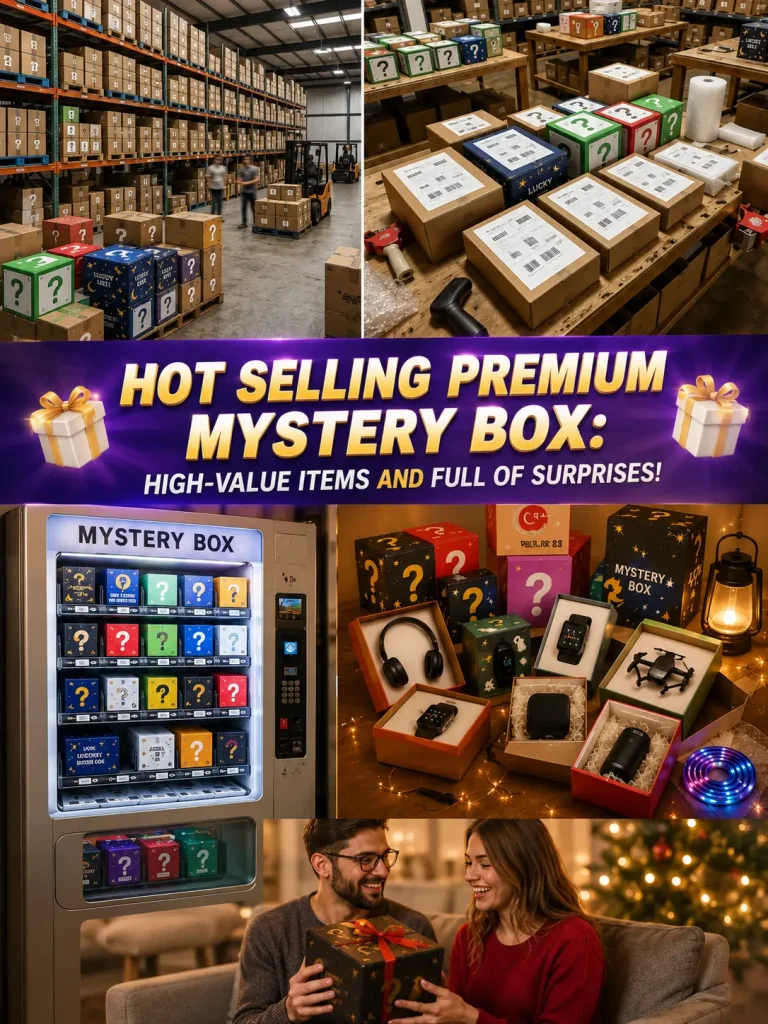
A mystery box company does not sell surprise. It sells the gap between what stock costs to acquire in bulk and what a sealed box of it fetches at retail, and everything about the product you receive, the item counts, the recurring earbuds, the vague category names, follows from that gap. Once you can see how a mystery box business is put together, most of the confusing things about the boxes stop being confusing, and you buy better for it.
Where the Stock Comes From
Every mystery box company you buy from runs on cheap inbound goods. There are four main supply lines, and which one your seller uses explains most of what you receive. Customer returns are the largest by far. The National Retail Federation, working with Happy Returns, projected US retail returns of $849.9 billion for 2025, with an estimated 19.3% of online sales coming back. Retailers cannot economically restock all of that, so it is sold on in bulk, and some of it ends up in the carton you open to liquidators and from there into assortments; the same research found 9% of returns are fraudulent, which is where the occasional empty or swapped box comes from. Overstock and end-of-line goods are new, boxed, but unsold, cleared at a fraction of wholesale. Factory-direct small electronics are accessories bought new from makers in volume, the cleanest supply and the one that produces "all new" boxes. Recovered mail is real but tiny; the romance of the "unclaimed package" is dismantled in what is actually inside a box of returns.
The Cost Stack Behind One Box
- Carriage and packaging are fixed per parcel and come off the top before any goods.
- Goods are bought at a fraction of retail, which is why "retail value" claims are cheap to make and mean little to you.
- The seller's real risk is variance: one expensive item in one box wrecks the margin on fifty, which is why it is never there.
- Judge a company on its supply line, its filler cap, and its testing, the three things it can be held to.
Take a $30 box you might buy and follow your money in the order the seller spends it.
| Line | Nature | Who sets it |
|---|---|---|
| Carriage | Fixed per parcel; a domestic ground parcel starts around $8 | The carrier |
| Packaging and labour | Box, filler, label, minutes to pack | Volume |
| Payment processing | A percentage plus a fixed fee | The processor |
| Goods | Bought in bulk at a fraction of retail | The supply line |
| Returns and faults | A reserve against the small tail of problems | How much testing is done |
| Margin | What is left | Everything above |
Two things follow for you. First, at low prices the goods line is the residual, not the starting point, which is why cheap boxes contain small, light accessories; the arithmetic is worked through in what to realistically expect under $20. Second, because goods are acquired far below retail, quoting a large "retail value" costs the seller nothing and commits it to nothing.
Why the Same Items Keep Showing Up
You may notice that different people receive the same earbuds or the same speaker from one seller and read it as laziness. It is structure. In the US, anything that transmits, Bluetooth, Wi-Fi, a wireless dongle, needs FCC equipment authorisation before it can be marketed or imported, and that authorisation attaches to a model rather than a shipment. The testing and approval are paid for once per product and spread across every unit sold, including the one in your box. For an assortment company the consequence is direct: buying many units of a few already-approved wireless models is far cheaper than sourcing variety. So the wireless items in a mixed box cluster around a handful of recurring models, while the cheap passive accessories can vary freely. The tier structure this produces is laid out in what tech means on a mystery box listing.

What the Company Is Actually Optimising
Not your surprise. Three quieter things. Variance control. Randomness is the product you paid for and a liability for the seller. A box that accidentally contains something worth far more than its price does not make one customer happy; it makes the whole line unprofitable, because the seller has to fund it from the margin on many other boxes. So contents are drawn from a controlled pool with a known average, and genuinely expensive items are kept out. This is why the laptop you saw is in the marketing image and not in your carton. Weight. Carriage scales with weight and size, so light items are structurally preferred. Cables, earbuds, and cases weigh almost nothing; a speaker in your box is a decision. Item count as the headline. Count is the number a listing leads with because it is the cheapest number to raise. Adding a fourth cable costs the seller cents and lets the listing say "5 items" instead of "4". A serious seller states the count and also caps how many low-value fillers it allows per box; a less serious one just states the count.
Note: "Contains $150 of retail value" is not a lie and not a promise to you. It is the sum of list prices the seller assigns to items it bought for a fraction of that, and it cannot be checked before purchase or, usually, after. Item count, condition, and category range are the three things a mystery box company can actually be held to, and they are the three things you should read for.
Where the Money Is
Margin per box is thin at the cheap end. Mystery box companies make their money in three places that are not your first order. Tiers: the mid and upper tiers carry most of the profit, because carriage and packaging barely rise while the price does; the cheap box is the entry point. Repeat purchase and subscription: a subscriber converts one acquisition cost into many orders, and one well-known seller prices month-to-month at $34.99 and three months prepaid at $33.33, a saving of under five per cent, which tells you the prepay tier is selling commitment rather than discount. Bulk and event orders: if you order thirty boxes in one shipment, that pays carriage once and sells the seller's average assortment thirty times, with none of the variance risk of a single box.
Imports changed in August 2025, when US Customs and Border Protection ended duty-free de minimis treatment for goods valued at or below $800 from all countries. Sellers holding US stock had already cleared it in bulk at wholesale value; sellers shipping from origin now pass that duty to you or price it in. That single rule reshaped which companies can compete for you at the cheap end, and it is why you should read the duty line on any overseas listing.
What This Means When You Buy
- Judge the supply line, not the branding. New factory stock, overstock, and returns are three different products with three different fault rates, and you are paying for one of them.
- Read the count alongside a filler cap. "6 items" means little to you without knowing how many can be cables.
- Expect recurring wireless models. It is certification economics, not laziness, and it tells you your seller buys in volume.
- Treat retail value as marketing. Ask instead whether items are tested before dispatch and what happens when one fails.
- Buy up a tier rather than buying twice. Carriage is the fixed cost; your second box pays it again.
Mewoo is a small example of the factory-direct model: new accessories bought in volume, checked before packing, with the count and condition stated on each tier. How that check works is in how Mewoo tests electronics before dispatch.
FAQ
How do mystery box companies make money?
On the difference between what a pallet of goods costs them and what a sealed box of it sells for, minus the postage and packing that every parcel pays whatever is inside. The cheapest box barely makes anything; the profit sits in the bigger tiers, in customers who order again, and in bulk orders where one shipment sells the average assortment thirty times over. Knowing that tells you where your money goes.
Where do mystery box companies get their products?
From whoever is selling cheaply in volume: retailers clearing customer returns by the pallet, distributors shifting unsold or discontinued stock, and factories selling accessories direct in bulk. The unclaimed-mail supply that the ads love is a rounding error, filtered by the postal service and sold in opened lots. Ask a seller which of those they buy from and the answer predicts what condition your box arrives in.
Why do different people get the same items from one seller?
Every wireless gadget sold in the US has to be certified as a model before it can be imported, and that certification is paid for once and shared across every unit. So a company that has an approved pair of earbuds is far better off buying a thousand of them than sourcing twenty different pairs. The repeats you see in unboxing videos are that maths at work, not a packer who could not be bothered.
Is the "retail value" figure on a mystery box real?
It is a number the seller wrote down, adding up list prices for goods they paid a fraction of. Nothing stops them stating it, nothing lets you verify it, and it binds them to nothing if the box arrives short. Put your attention on the three promises a seller can be held to instead: how many items, in what condition, and from which categories, with what is excluded.
Why are expensive items never actually in the box?
Because one lucky customer would be paid for by dozens of unlucky ones. If a $30 box occasionally held a $300 device, the seller would have to recover that $270 from the margin on many ordinary boxes, and the line would stop making money. So the contents come from a pool with a known average and the expensive items stay in the marketing photograph, where they illustrate the category rather than describe your parcel.
Did the 2025 US customs change affect mystery box companies?
A great deal. From 29 August 2025, parcels worth $800 or less stopped entering the US duty-free, from every country and by post as well as courier. A company that had already imported stock in bulk had paid duty once at wholesale value and carried on; a company shipping each box from abroad now has to charge you the duty or absorb it in the price. Cheap direct-from-origin boxes got noticeably less cheap overnight.
Final Thoughts
A mystery box company is a bulk-goods business with a reveal on the front. Stock comes cheap from returns, overstock, and factory-direct accessories; carriage comes off the top; variance is controlled so no single box wrecks the margin; and the money is made in tiers, repeat orders, and bulk. Buy against the three things a seller can be held to, let the rest of the listing be scenery, and you get a more predictable box for the same money.
To see the factory-direct model with the count and condition stated on the page: Triple Reveal Electronics Mystery Box (3 items) and Party Electronics Mystery Box (6 items). Compare every tier side by side on the electronics mystery box category page.
See how Mewoo tests before dispatch →